Cervical Spondylosis: Symptoms, Causes, Ayurvedic Treatment and Panchakarma
“My neck feels heavy as soon as I wake up…”
“It hurts when I turn my neck to the right…”
“After working on my laptop for a while, both my neck and shoulders start hurting…”
“Sometimes the pain even travels down to my arm…”
If you have experienced any of these symptoms, you understand how disturbing and uncomfortable neck pain can be.
Morning stiffness in the neck…
Holding your neck repeatedly while working…
Discomfort while looking at your mobile phone…
And even at night, trying to find a sleeping position that reduces the pain.
Initially, we often do not take these symptoms seriously.
Sometimes we apply oil.
Sometimes we use a warm-water compress.
Sometimes we take a painkiller because someone suggested it.
The pain reduces a little, and we think—
“Okay, now it is better.”
But after a few days, the same problem comes back.
And this is where the question begins—
“Why does my neck pain keep coming back?”
If an examination shows Cervical Spondylosis, there is no need to panic.
However, understanding the condition and taking proper guidance at the right time is important.
What Exactly Is Cervical Spondylosis?

In simple language, Cervical Spondylosis is a condition associated with degenerative changes in the cervical spine that can develop over time.
Age can be one of the factors.
But it is not correct to assume that only older people experience this problem.
Our daily lifestyle can also put considerable stress on the neck.
For example:
- Working on a laptop for long hours
- Constantly looking down at a mobile phone
- Sitting in the same position for several hours
- Poor sitting posture
- Very little physical activity
- Continuous strain on the neck and shoulders
This is why many young people also ask—
“I am still young, so why did I develop Cervical Spondylosis?”
The answer may also lie in your lifestyle and the daily stress placed on your neck.
First Comes the Pain… Then We Ignore It
Imagine that you wake up one morning with mild stiffness in your neck.
You think—
“Maybe I slept in the wrong position.”
The next day, there is some pain again.
You apply oil.
Then you use a warm-water compress.
The pain reduces.
A few days later, you spend more time working on your laptop and the neck pain returns.
Then a painkiller.
Then some rest.
And then the same routine repeats.
If this cycle keeps happening, simply reducing the pain may not be enough.
You need to understand:
- Why does the pain keep coming back?
- What is your posture like?
- How long does your neck stay in the same position?
- Is there muscle tightness?
- Is the pain travelling towards the shoulder?
- Are you experiencing tingling or weakness in your arm?
This information can help in understanding the condition and planning appropriate treatment.
Is Neck Pain Alone a Sign of Cervical Spondylosis?
Not necessarily.
Cervical Spondylosis symptoms can vary from person to person.
Some people may experience only neck pain.
Others may experience:
- Neck stiffness
- Difficulty turning the neck
- Shoulder pain
- Discomfort extending from the neck to the shoulder
- Tingling in the arm
- A feeling of heaviness in the arm
- Increased pain after sitting for long periods
This is why it is not appropriate to diagnose yourself based on just one symptom.
A proper evaluation is important to understand the actual cause.
Why Might Panchakarma Be Considered for Cervical Spondylosis?
There is one important point to understand here.
Not every Cervical Spondylosis patient needs the same treatment.
In Ayurveda, the patient may be assessed according to their overall condition.
An Ayurvedic physician may consider factors such as:
- Your symptoms
- The stage and nature of the condition
- Your physical strength
- Your Prakriti
- Your daily routine
- Your age and overall health
- The severity of pain and stiffness
Based on this assessment, an appropriate treatment plan may be decided.
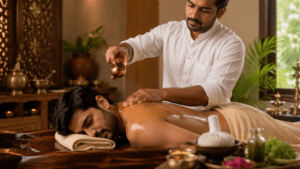
In some suitable patients, Ayurvedic treatment for Cervical Spondylosis may include selected therapies, and in certain cases, Panchakarma for Cervical Spondylosis may be considered.
The purpose may be to support the management of symptoms such as pain, stiffness and movement-related discomfort.
Is Panchakarma Just One Procedure?
No.
This is something many people do not know.
Panchakarma is not a single therapy.
It consists of different therapeutic procedures.
Every patient does not require every procedure.
For example, depending on the individual’s condition, an Ayurvedic physician may consider procedures such as:
- Snehana
- Swedana
- Other suitable Ayurvedic external therapies
However, which therapy is suitable for you should not be decided simply by searching on the Internet.
First assessment → Then a personalised treatment plan.
Why Do the Neck and Shoulders Always Feel Tight?
Take a moment to observe how you work.
You are sitting in front of your laptop…
Your neck is slightly forward…
Your shoulders are slightly raised…
And this position continues for two or three hours.
Then, when you finally get up—
“Oh! My neck feels completely stiff.”
Often, we do not even realise how long we have been sitting in an uncomfortable position.
If this happens every day, the strain on the neck and shoulder muscles may increase.
Therefore, along with Cervical Spondylosis treatment, paying attention to your daily habits is also important.
Do a Quick Posture Check Right Now
Look at your sitting position right now.
Ask yourself:
- Is your neck positioned forward?
- Are your shoulders tight?
- Is your laptop placed too low?
- Do you constantly bend your neck while using your mobile phone?
- Do you sit for several hours without taking a break?
If the answer to several of these questions is “Yes,” it may be time to start paying more attention to your daily posture.
Small changes in your routine can make a difference.
Simple Tips for People Who Work on a Laptop
If your work involves using a laptop, keep these points in mind:
- Keep the screen as close to eye level as possible.
- Avoid sitting in the same position continuously for several hours.
- Get up and move around at regular intervals.
- Avoid working with your neck continuously bent forward.
- Do not keep your shoulders unnecessarily tight.
You may not be able to stop working.
But you can change the way you work.
Mobile Phone Use Can Also Increase Neck Stress
Today, our mobile phones are almost always in our hands.
Messages…
Instagram…
YouTube…
Reels…
Work…
And what is one of the most common postures?
Mobile down and neck down.
Doing this for a few minutes is different.
But if you maintain this posture for long periods every day, it may increase strain on the neck and surrounding muscles.
So, try to hold your mobile phone a little higher and avoid keeping your neck bent for long periods continuously.
“My Neck Pain Travels Down to My Arm…”
If your pain travels from your neck towards your shoulder or arm, do not casually ignore it.
Especially if it is accompanied by:
- Persistent tingling
- A feeling of heaviness in the arm
- Weakness
- Difficulty holding objects
proper medical evaluation is important.
Not every type of arm pain is caused by Cervical Spondylosis.
Therefore, understanding the actual cause should come first.
Does Panchakarma Permanently Eliminate Neck Pain?
It would not be appropriate to give such a guarantee.
Every person’s condition is different.
Some people may experience improvement in symptoms sooner, while others may take more time.
For many people, along with treatment, attention to lifestyle changes and appropriate exercises may also be important.
Therefore, the idea that “one session will permanently eliminate the problem” is not correct.
Treatment should be planned according to the individual’s complete condition.
Your Lifestyle Is Also Part of Your Treatment
Suppose you get relief after treatment.
But after that, you:
- Sit continuously for 8–10 hours every day
- Work on your laptop with your neck bent forward
- Use your mobile phone continuously while looking down
- Do very little movement
- Ignore your posture
Then the problem may trouble you again.
Therefore, along with treatment, it is important to work on your daily habits as well.
Does Every Neck Pain Require Panchakarma?
Absolutely not.
This is one of the most important things to understand.
Every neck pain is not Cervical Spondylosis.
And every Cervical Spondylosis patient necessarily needs Panchakarma.
The cause can be different, and therefore the management may also be different.
For example:
- If it is muscle strain, the approach may be different.
- If there are degenerative changes in the spine, the approach may be different.
- If there are nerve-related symptoms, careful evaluation may be necessary.
- If the pain started after an injury, a different assessment may be required.
This is why personalised Ayurvedic treatment is important.
When Should You Seek Immediate Medical Evaluation?
Some symptoms should never be ignored.
If neck pain is accompanied by:
- Increasing weakness in the arms or legs
- Persistent or worsening numbness or tingling
- Difficulty maintaining balance while walking
- Sudden difficulty moving the hands
- Neck pain after a serious injury
- Changes in bladder or bowel control
you should seek appropriate medical evaluation promptly.
In such situations, it is not appropriate to simply apply oil or use a warm compress at home and wait.
Finally, Ask Yourself One Question…
“Did my neck pain really start today, or has my body been giving me signals for a long time?”
Perhaps—
You have been ignoring stiffness for months.
Your neck stays forward while working.
Your shoulders are always tight.
You keep taking painkillers repeatedly just to manage the discomfort.
And now your neck pain is affecting your sleep, work or daily routine.
If this sounds familiar, instead of repeatedly suppressing the pain, it is important to understand its underlying cause.
After proper assessment, suitable patients may be considered for Ayurvedic treatment for neck pain, selected therapies and, in certain cases, Panchakarma treatment as part of a personalised management plan.
At the same time, paying attention to posture, movement, exercise and lifestyle is equally important.
Don’t Let Neck Pain Control Your Daily Life
Waking up every morning holding your neck does not have to be considered normal.
Having to repeatedly massage your neck while working should not simply be ignored.
And repeatedly taking painkillers while ignoring recurring pain is not a long-term solution.
If Cervical Spondylosis symptoms are repeatedly troubling you, consider getting a proper assessment at the right time.
Understand the cause.
Understand your condition.
And choose the right treatment plan for you.
Aptashri Ayurveda & Panchkarma Clinic, Pune
Dr. Saurabh B. Kadam, M.D. (Ayu)
For Cervical Spondylosis, neck pain, stiffness and other musculoskeletal complaints, seek appropriate Ayurvedic assessment and personalised treatment planning from a qualified healthcare professional.